7 Common Financial Blind Spots for High Earners
High earners often do everything right. They earn well, save consistently, and work with professionals. Still, many fall short of their long term potential.
Below are the most common financial blind spots high earners face and how each one undermines otherwise strong financial habits.

Blind Spot 1: Tax Planning That Is Not Integrated
High earners rarely rely on one income stream. Salary, bonuses, equity compensation, commissions, and business income are all taxed differently. When each source is managed separately, withholding and estimated payments fall out of sync.
The result shows up at tax time through unexpected bills, cash flow stress, and rushed decisions. This is not a tax rate issue. It is a coordination failure. Without integration, tax planning becomes reactive instead of strategic, increasing lifetime taxes and limiting how income can be managed.
Blind Spot 2: Hidden Concentration Risk
Many high earners build wealth through one company or business. Stock accumulates across retirement plans, employee purchase programs, equity awards, and brokerage accounts. Each account may appear diversified on its own, but across the full balance sheet, risk concentrates quietly.
When a single company represents too much of net worth, one downturn can erase years of progress. Because the exposure is spread across accounts, most people do not see the risk until it is too late. Without a consolidated view, concentration hides in plain sight.
Blind Spot 3: Asset Location on Autopilot
High earners face higher marginal tax rates, which makes asset placement critical. Yet many investments end up in accounts based on convenience rather than strategy. Income producing assets sit in taxable accounts, while growth assets sit in tax deferred accounts, creating unnecessary taxes year after year.
This does not feel like a mistake. It shows up as weaker compounding over time. Asset location does not change what is invested. It changes where each asset lives so taxes are minimized and long term results improve.
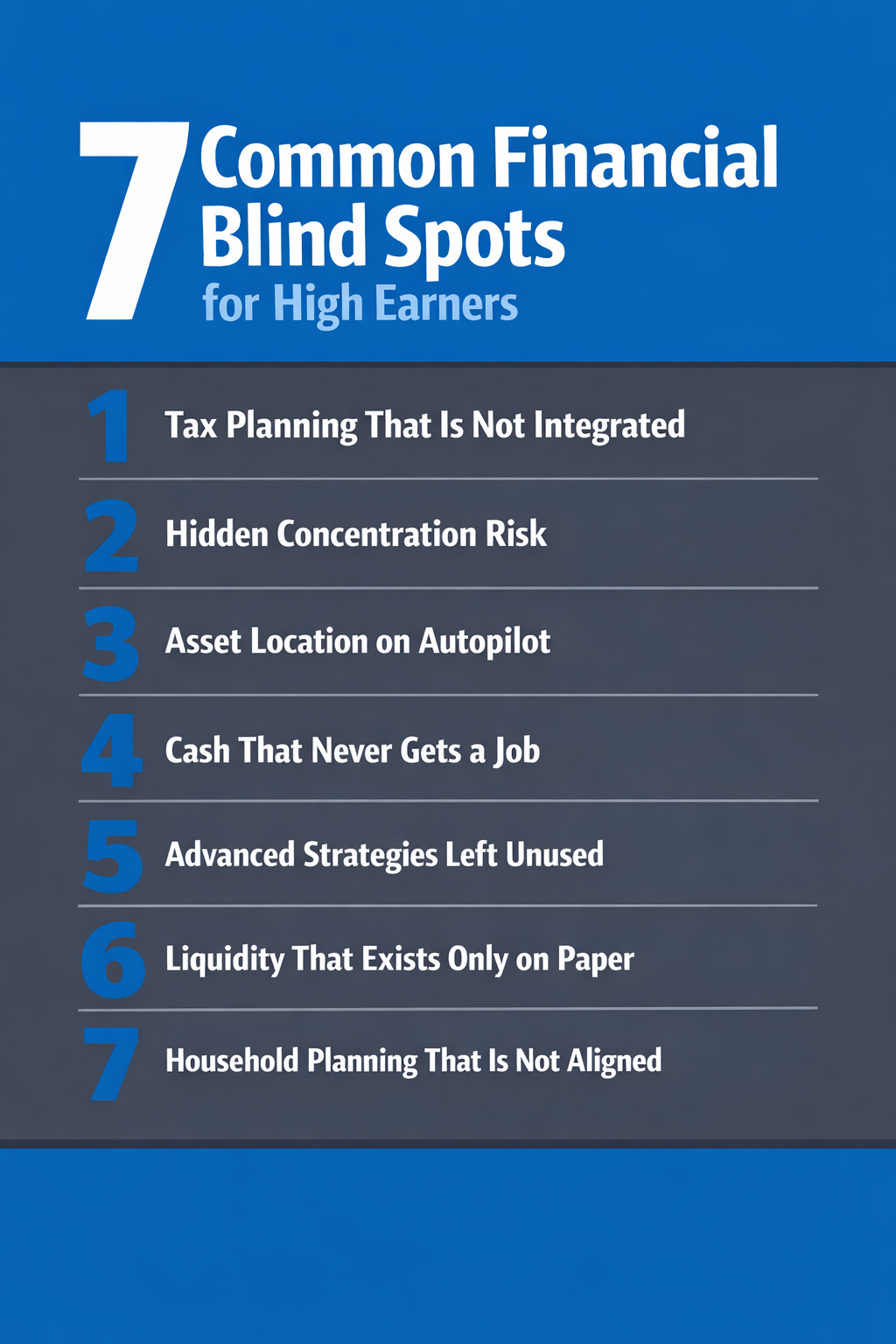
Blind Spot 4: Cash That Never Gets a Job
High income often leads to excess liquidity. Money builds up in checking and low yield savings because investing decisions feel complex or time constrained.
Cash feels safe, but inflation and missed growth quietly reduce purchasing power over time. High earners rarely struggle to save. They struggle to deploy capital with intention.
Blind Spot 5: Advanced Strategies Left Unused
Many high earners qualify for planning tools that never get implemented.
Common examples include:
Backdoor Roth strategies
Donor advised funds for tax efficient giving
83b elections for early stage equity
Coordinated timing of equity compensation
Capital gain and charitable planning
When planning stays basic, flexibility and tax efficiency are left on the table. These tools do not require more risk. They require awareness and integration.
Blind Spot 6: Liquidity That Exists Only on Paper
Net worth does not equal access. High earners often hold wealth in equity, real estate, private investments, or business interests. On paper, balances look strong. In practice, accessing capital for opportunities or major expenses can be difficult.
Without a liquidity strategy, even financially successful households can feel constrained when timing matters. Liquidity is not about holding excessive cash. It is about ensuring funds are available when needed without disrupting long term plans.
Blind Spot 7: Household Planning That Is Not Aligned
In dual income households, one partner often manages finances. Compensation structures, benefits, and retirement plans are optimized individually rather than collectively.
This leads to:
duplicated strategies
missed tax opportunities
uneven risk exposure
inefficient account funding
When planning does not operate at the household level, blind spots multiply.
Why These Blind Spots Persist
None of these issues seems catastrophic on its own. They persist because most high earners already work with professionals. Investment advisors, CPAs, estate attorneys, and benefits consultants each manage part of the picture.
The problem is not expertise. It is isolation. Each specialist optimizes within a narrow scope. Taxes are handled separately from investments. Estate plans ignore long term cash flow. Equity decisions lack full tax integration. Everyone acts competently, yet the system fragments. This is the expert paradox. Specialists reduce risk in their domain but create risk across the full financial picture when coordination is missing.
What Coordinated Planning Actually Means
Coordination means every decision flows from one strategy.
Taxes shape how investments are structured.
Investments reflect liquidity and estate goals.
Equity compensation fits within risk management and cash flow planning.
Instead of reacting to each event independently, decisions follow a unified framework.
This approach is often described as a personal CFO model. Not a product focused advisor. Not a single account manager. A strategic role that oversees the architecture of the entire financial system.
Key questions guide every decision:
How does this equity grant affect future tax exposure
What does this asset sale mean for long term income
How does a trust update change portfolio structure
Where should each dollar live to reduce friction
How to Identify Financial Blind Spots
A few direct questions reveal whether planning is coordinated or fragmented:
Does anyone review the full balance sheet, tax picture, and income sources at once
Do investment decisions actively reduce long term tax exposure
If employment ended tomorrow, would a cash flow plan already exist
Can every major account be explained as part of one strategy
If these questions are difficult to answer, the issue is not falling behind. It is operating without alignment.
The Payoff of Closing the Gaps
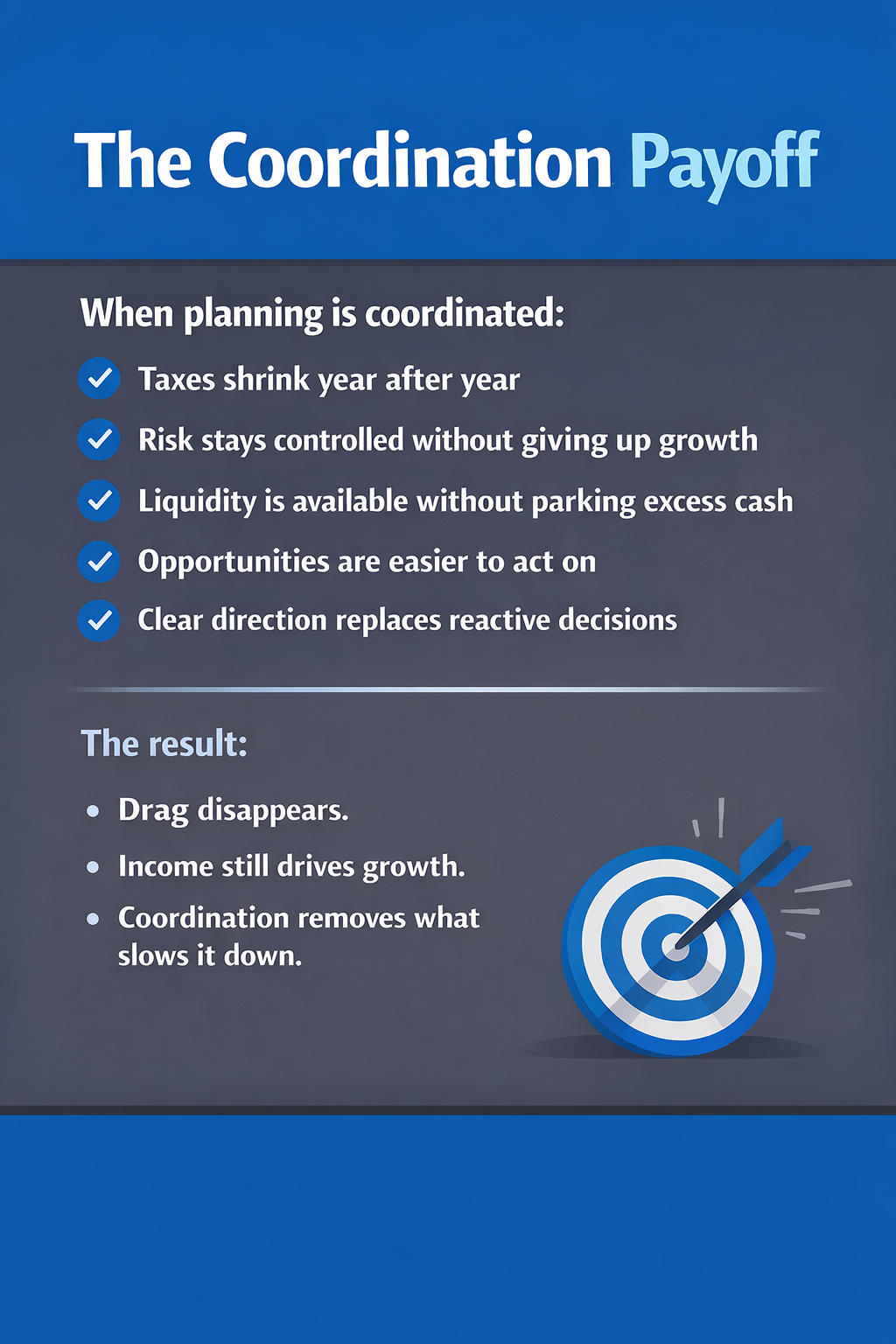
When planning becomes integrated:
unnecessary taxes decline year after year
risk is managed intentionally without sacrificing growth
liquidity becomes accessible without hoarding cash
opportunities become easier to pursue
clarity replaces reaction
Most importantly, drag disappears.
Income continues to drive growth. Coordination removes what slows it down.
How ONE Advisory Partners Helps You
Making financial decisions gets harder when investments, taxes, retirement income, and long term goals all move at once. At ONE Advisory Partners, Jordan Jensen helps bring these pieces into one clear strategy. He takes a coordinated planning approach that aligns your portfolio, cash flow, and tax considerations so each decision supports the next. The focus is not on products. It is on structure, clarity, and long term direction.
Jordan combines deep market experience with practical financial life planning. He works with you to build an investment plan that fits your goals, map out retirement income, and identify tax smart ways to strengthen your strategy. Whether you are growing wealth, preparing for retirement, or navigating a major financial transition, Jordan helps reduce blind spots and guide decisions with confidence and purpose.
Bottom Line
High earners do not fall short because they lack discipline, knowledge, or access to advice. They fall short because complexity creates blind spots.
Financial success does not simplify decision making. It demands coordination.
When every part of the financial system works together, wealth compounds more efficiently, risk becomes intentional, and long term outcomes improve.
The difference is not effort. It is structure.
FAQs Financial Blind Spots for High Earners
What are the most common financial blind spots for high earners?
High earners often miss tax integration, asset location, concentration risk, liquidity planning, and coordinated household strategies.
Why do high earners still fall short financially?
Because complexity creates blind spots. Multiple income streams, accounts, and advisors often operate in silos without a unified strategy.
How does poor tax coordination affect high earners?
It leads to higher lifetime taxes, missed planning opportunities, and reactive decisions that reduce long term efficiency.
What is concentration risk for high earners?
It occurs when too much net worth is tied to one company, business, or asset class, often through employer stock or equity compensation.
What does asset location mean in financial planning?
Asset location means placing investments in the most tax efficient accounts. Poor placement increases taxes and weakens compounding over time.
Why is excess cash a problem for high earners?
Uninvested cash loses value to inflation and missed growth. High earners often save well but fail to deploy capital strategically.
What is liquidity planning and why does it matter?
Liquidity planning ensures access to capital when needed. Without it, wealth may exist on paper but remain difficult to use.
Why do dual income households face more blind spots?
Because planning is often done separately, leading to duplicated strategies, missed tax benefits, and uneven risk exposure.
What is coordinated financial planning?
It aligns taxes, investments, estate planning, liquidity, and income under one strategy so every decision supports long term goals.
How can a high earner identify blind spots?
If no one reviews the full financial picture at once or decisions feel reactive instead of strategic, coordination is likely missing.
Reference
Forbes. (2011). 3 Common Financial Blind Spots. Financial Finesse. Retrieved from
https://www.forbes.com/sites/financialfinesse/2011/10/27/3-common-financial-blind-spots/
Investopedia Staff. (2024). Experts Warn That High Earners Make These Costly Mistakes. Investopedia. Retrieved from
https://www.investopedia.com/experts-warn-that-high-earners-make-these-costly-mistakes-11763752