How Asset Location Changes When You Shift From Properties to Portfolios
When you move from rental properties to investment portfolios, where you place each asset matters as much as what you own. Asset location lets you replace rental income while reducing taxes by matching each investment with the account type that treats it most efficiently.
This is how you replace rental income without recreating the same tax burden.

What Asset Location Actually Means
Asset location is not asset allocation. Allocation decides how much you invest in stocks, bonds, or cash. Location decides where each of those investments should live for tax purposes.
An asset location strategy pairs tax inefficient investments with tax advantaged accounts and tax efficient investments with taxable accounts. The goal is simple. Reduce tax drag so more of your money stays invested and compounds over time.
Some assets trigger taxes every year. Others allow you to control when and how you pay. If you ignore that distinction, you recreate the same tax exposure you had with rental income.
Get Your Free Guide to Real Estate Exit Strategies
Why the Shift From Properties Changes the Rules
Rental income is taxed as ordinary income. Depreciation can help in the early years, but long term you still report income that sits in the highest tax brackets.
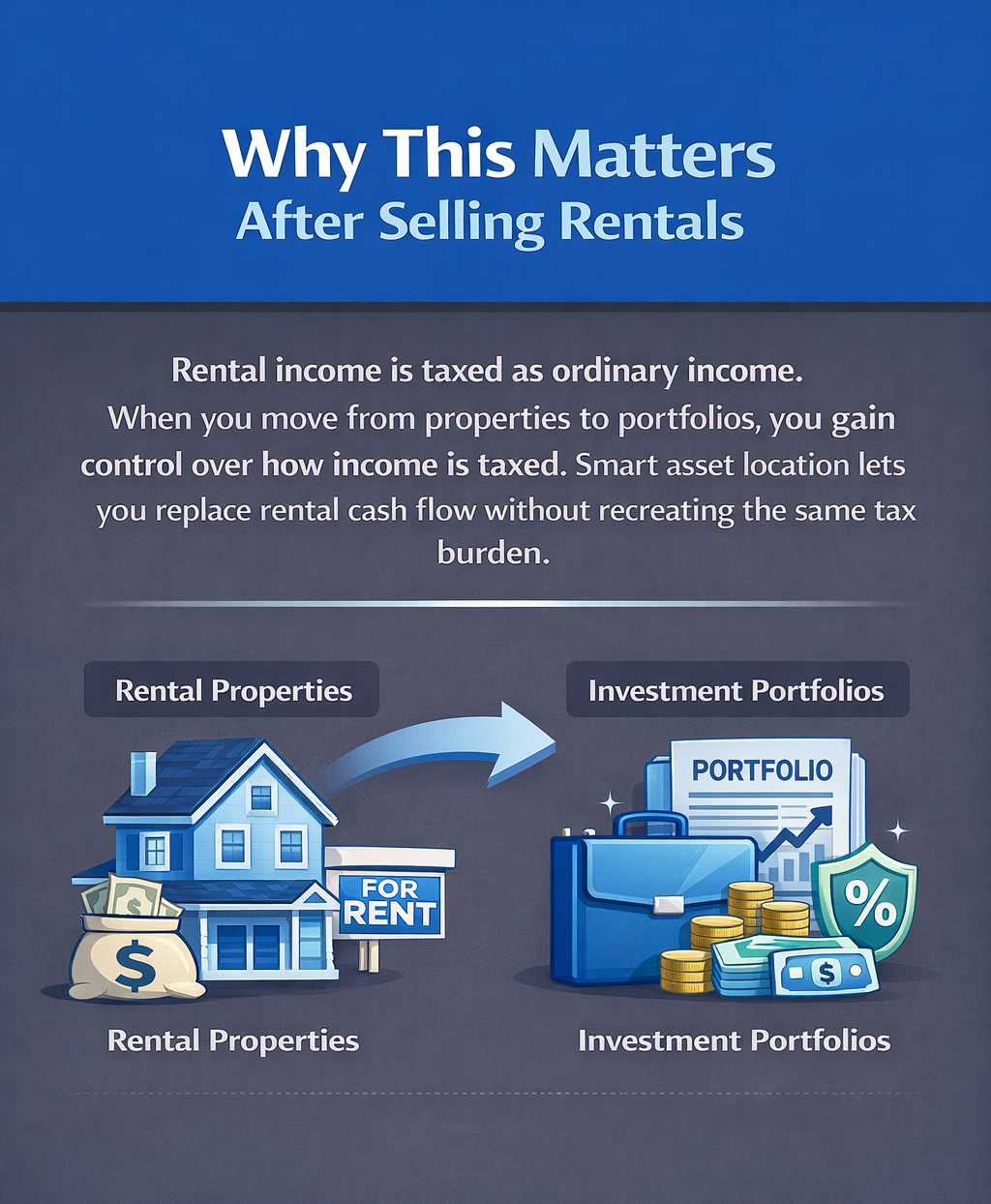
When you sell property and reinvest in portfolios, you can structure income differently. Some income can grow without annual taxes. Some gains qualify for lower capital gains rates. Some income can become fully tax free.
This shift gives you flexibility that rental properties never offered. But only if you place the right assets in the right accounts.
Where Income Producing Assets Belong
Some investments behave like rental properties. They generate regular income that the IRS treats as ordinary income.
These assets include:
Core bonds that pay steady interest
High yield bonds that produce higher income
Real estate investment trusts that must distribute at least 90 percent of income
Actively managed funds with frequent trading
Investments held less than one year that trigger short term capital gains
When you hold these in a taxable account, every distribution creates a tax bill. That ongoing tax drag reduces compounding year after year.
The solution is straightforward. Place these assets inside tax deferred or tax exempt accounts such as IRAs or 401k plans. Inside these accounts, income is not taxed annually. The money stays invested and continues to grow until you withdraw it later.
This mirrors what rental income once provided but removes the yearly tax hit.
Where Growth Assets Belong
Other investments grow in value rather than paying out income.
These include:
Individual stocks held for the long term
Index funds and exchange traded funds
Tax managed mutual funds
Assets you plan to hold for more than one year
When you hold these in taxable accounts, you control when you recognize gains. Long term capital gains face lower tax rates than ordinary income. Qualified dividends also receive favorable treatment.
By placing growth assets in taxable accounts, you gain flexibility. You can manage gains year by year. You can harvest losses to offset income. You can decide when to sell based on tax planning, not just market conditions.
This is a major change from property ownership, where income arrives whether you want it or not.
Why Roth Accounts Deserve Your Highest Growth Assets
Roth accounts offer a third category. They allow investments to grow and be withdrawn tax free.
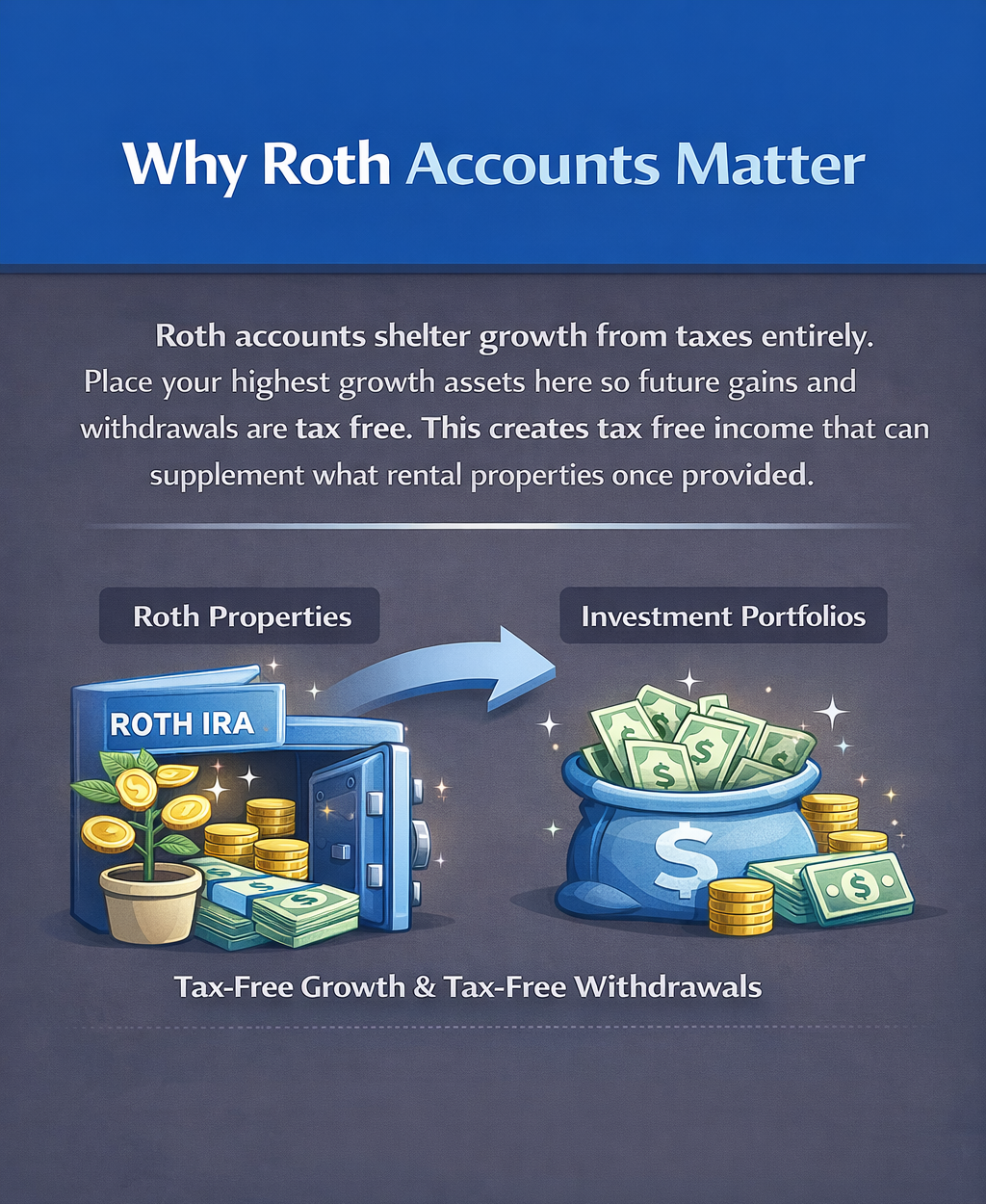
This makes them ideal for your highest growth assets. If an investment has strong long term appreciation potential, placing it in a Roth account converts future gains into tax free income.
For former property owners, this creates a powerful replacement for rental cash flow. Instead of paying ordinary income tax on rent, you generate future income that never faces taxation.
Why You Cannot Put Everything in Tax Advantaged Accounts
If asset location is so effective, why not hold everything inside tax sheltered accounts?
Two reasons limit that approach.
First, tax advantaged accounts have annual contribution limits. You cannot move unlimited capital into them.
Second, some accounts impose income restrictions that prevent high earners from contributing directly.
As a result, most investors must use taxable brokerage accounts alongside retirement accounts. That makes asset location essential. You cannot avoid taxable accounts, but you can control what you hold inside them.
How Much Asset Location Can Actually Save
Research cited in the document shows that asset location can increase after tax returns by 0.14 to 0.41 percentage points per year for conservative investors in mid to high tax brackets.
For a retired couple with a two million dollar portfolio split evenly between taxable and tax advantaged accounts, that translates to:
About 2800 to 8200 dollars per year in reduced tax drag
More money available for reinvestment or living expenses
Higher long term portfolio sustainability
Most of the benefit comes from two simple changes:
Using municipal bonds instead of taxable bonds in taxable accounts, especially for higher income investors
Holding passive stock funds in taxable accounts and placing actively managed funds inside tax advantaged accounts
These adjustments reduce taxable distributions and improve after tax performance without changing overall risk.
How to Course Correct Existing Portfolios
Many investors already hold assets in the wrong accounts. Fixing that requires care because selling in taxable accounts can trigger capital gains.
These are practical ways to realign without creating unnecessary taxes:
Harvest losses to offset income and free up capital for better placement
Turn off automatic reinvestment of interest and dividends and redirect that income into more tax efficient assets
Gradually remove tax inefficient assets from taxable accounts during annual withdrawals
Make changes inside tax advantaged accounts first since trades there do not trigger immediate taxes
The key is sequencing. You want to improve tax efficiency without disrupting your overall risk profile.
Tax planning should never override portfolio structure. Maintain your allocation first. Improve location second.
What This Means for Former Property Owners
When you sell rental property and move into portfolios, your tax profile changes. You no longer have to accept ordinary income on every dollar of cash flow. You can design where income appears, how it gets taxed, and when you recognize gains.
Asset location allows you to:
Replace rental income with portfolio income while lowering taxes
Convert taxable cash flow into deferred or tax free growth
Improve long term sustainability without increasing risk
Retain flexibility for withdrawals, rebalancing, and estate planning
This is not a complicated strategy. It is a structural one. You match each investment to the account that treats it best under the tax code.
When you make that shift correctly, portfolios do not just replace properties. They outperform them on an after tax basis.
How ONE Advisory Partners Helps You
Selling a rental property in retirement does more than change where your income comes from. It affects taxes, cash flow, Medicare costs, and how your portfolio supports you over time. William Snider helps you evaluate the tax impact of a sale, how it reshapes your income strategy, and how to reinvest the proceeds using asset location so your money works more efficiently with less tax drag.
You do not have to make this decision on your own. If you want clear guidance on selling a rental property or creating a stable retirement income plan, schedule a conversation with William Snider at ONE Advisory Partners. He serves clients nationwide and helps you choose the path that strengthens your retirement.
Book a call with William Snider.
Get Your Free Guide to Real Estate Exit Strategies
Bottom line
Selling rental property changes how your income is taxed and how your wealth should be structured. With the right asset location, portfolios can replace rental income with greater flexibility and lower long term tax drag.
Asset Location FAQs for Investors Moving From Rental Property to Portfolios
What is asset location in investing
Asset location is the practice of placing different investments in specific account types based on how they are taxed. The goal is to reduce tax drag and increase after tax returns.
How is asset location different from asset allocation
Allocation decides how much you invest in stocks, bonds, or cash. Location decides which account type holds each of those investments.
Why does asset location matter after selling rental property
Rental income is taxed as ordinary income. After moving into portfolios, asset location allows you to structure income so it faces lower taxes or no taxes at all.
Which investments belong in tax deferred accounts
Bonds, high yield bonds, REITs, actively managed funds, and short term holdings work best in tax deferred accounts because they generate regular taxable income.
Which investments belong in taxable accounts
Stocks held long term, index funds, ETFs, tax managed funds, and qualified dividend producing assets belong in taxable accounts due to favorable capital gains treatment.
What should I place in a Roth account
High growth assets belong in Roth accounts so future gains and withdrawals remain tax free.
Can asset location increase retirement income
Yes. Research shows it can reduce annual tax drag and increase after tax returns, potentially adding thousands of dollars per year in usable income.
Should I sell assets to fix poor asset location
Not immediately in taxable accounts. Use loss harvesting, dividend redirection, and gradual repositioning to avoid unnecessary tax bills.
Reference
Internal Revenue Service. (n.d.). Topic No. 409, Capital Gains and Losses. Retrieved from https://www.irs.gov/taxtopics/tc409
Chen, J. (2025, June 29). Asset Allocation. Investopedia. Retrieved from https://www.investopedia.com/terms/a/assetallocation.asp
Charles Schwab & Co. (n.d.). How Asset Location Can Help Save on Taxes. Schwab Center for Financial Research. Retrieved from https://www.schwab.com/learn/story/how-asset-location-can-help-save-on-taxes
H&R Block. (2025). 2025–2026 Tax Brackets and Federal Income Tax Rates. Retrieved from https://www.hrblock.com/tax-center/irs/tax-brackets/