8 Reasons Traditional Wealth Advice Breaks and Why a Virtual Family Office Fixes It
Traditional wealth advice breaks when coordination is missing, not access. You may have the right advisors, but if they are not aligned, your strategy drifts. Investment decisions ignore taxes. Estate plans fall behind. No one sees the full picture. That gap is where costly mistakes build.

Here are the 8 reasons traditional advice stops working and how to approach each one.
1. Investment Decisions Ignore Tax Impact
Most investment strategies focus on returns first. Taxes come later. That disconnect shows up when you sell assets without planning for capital gains or generate income that pushes you into a higher bracket.
Over time, this reduces your net results. You may take on unnecessary tax exposure simply because decisions were made in isolation.
The Right Approach: Build tax planning into every investment decision. Focus on what you keep after taxes, not just what you earn.
Read: What Are the 7 Tax Filing Mistakes Retirees Make That Cost the Most?
2. Estate Plans Drift Away From Your Financial Reality
Estate plans are often created once and left alone. Meanwhile, your financial life keeps changing. You add assets, shift ownership, or expand into new investments.
This creates a gap between your plan and your actual structure. When that gap grows, your wealth may not transfer the way you intended.
The Right Approach: Keep your estate plan active. Update it as your assets evolve so it reflects your current structure, not your past one.
3. Advisors Work in Silos
Your CPA, investment advisor, and attorney each focus on their own role. They are not built to coordinate unless you force the connection.
This leads to conflicting advice or missed opportunities. One decision may solve a problem in one area while creating a new one somewhere else.
The Right Approach: Create a system where advisors communicate regularly. Decisions should be made together, not separately
4. No Single View of Total Wealth
Your assets likely sit across multiple platforms. Brokerage accounts, private investments, real estate, and business interests all live in different places.
Without consolidation, you cannot clearly see your full net worth, risk exposure, or cash flow. You make decisions based on fragments.
The Right Approach: Bring everything into one view. A clear financial picture leads to better decisions across the board.
Also read: 8 Reasons Virtual Family Offices Are Becoming Essential For Modern Wealth Management
5. Complexity Grows Faster Than Strategy
As your wealth grows, complexity increases faster than your ability to manage it. You add more investments, more advisors, and more structures.
Each layer adds friction. Without a system, decisions slow down and costs increase. Risk becomes harder to track.
The Right Approach: Focus on coordination, not expansion. Growth should improve clarity, not reduce it.
6. Key Decisions Get Made in Isolation
Major financial moves often happen without full context. You may make an investment, complete a conversion, or restructure assets without seeing the full impact.
These decisions create ripple effects across taxes, estate planning, and income strategy. What looks right in one area may create problems in another.
The Right Approach: Evaluate every decision against your full financial picture. Each move should support your overall strategy.
7. You Become the Coordinator
When advisors do not communicate, you fill the gap. You manage emails, meetings, and decisions across multiple professionals.
This creates pressure and increases the chance of misalignment. You end up connecting strategies that should already be aligned.
The Right Approach: Shift coordination into a structured system. Your role should be oversight, not execution.
8. Strategy Fails to Adapt as Life Changes
Your financial life does not stay still. Markets shift. Family dynamics change. New opportunities come up.
Traditional advice often reacts slowly because each advisor works within their own lane. This leads to outdated strategies that no longer fit your situation.
The Right Approach: Build a system that adapts in real time. Your strategy should evolve as your life evolves.
Read: What Does A Virtual Family Office Do And Who Actually Needs One?
How a Virtual Family Office Fixes the Problem
A Virtual Family Office replaces disconnected advice with one coordinated system. Every part of your financial life works together instead of operating separately.
Investment strategy connects with tax planning. Estate planning reflects how your assets are structured. Advisors operate within one framework, not separate silos.
This gives you a single view of your wealth and a clear direction for every decision you make.
Key Outcomes When Your Financial Strategy Is Fully Coordinated
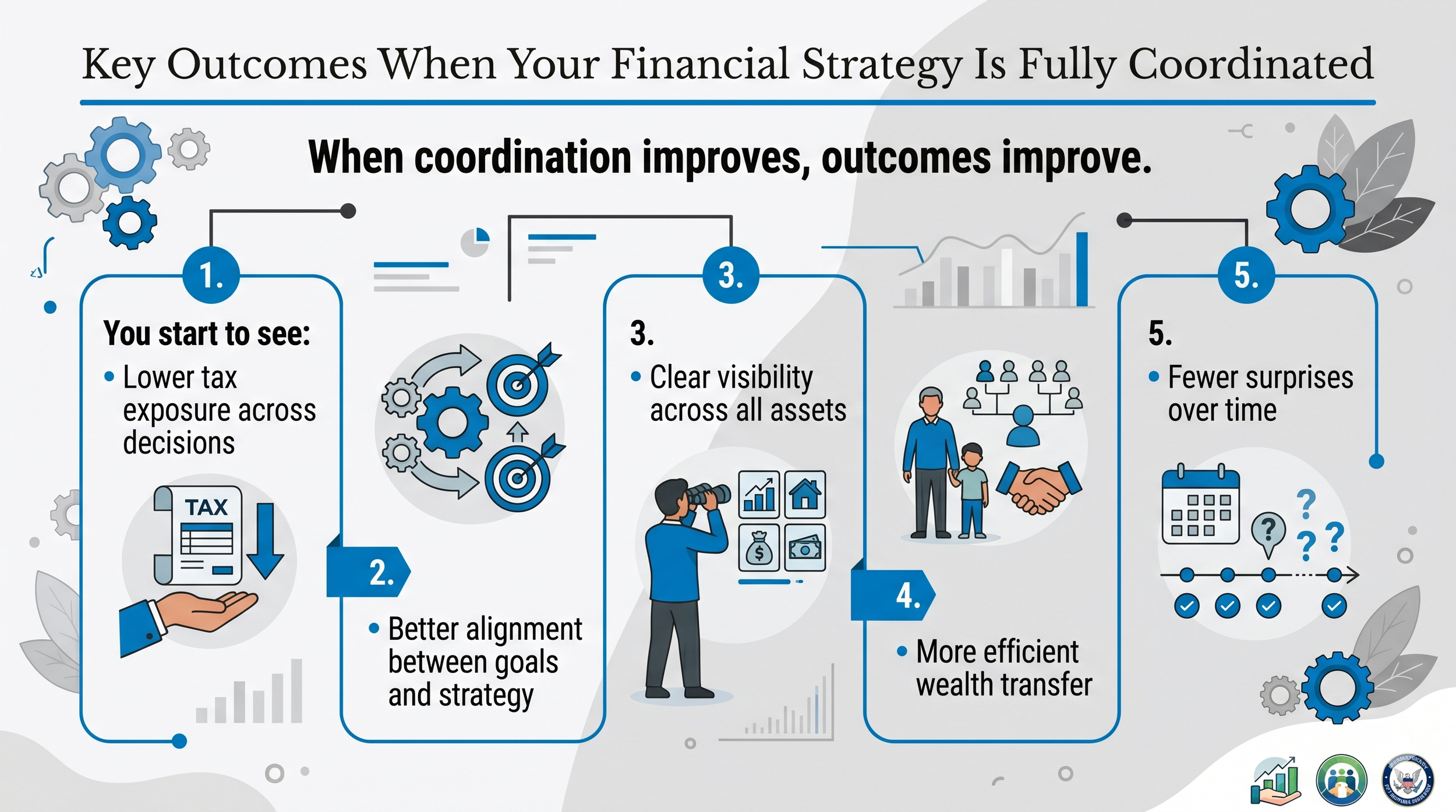
When coordination improves, outcomes improve.
You start to see:
Lower tax exposure across decisions
Better alignment between goals and strategy
Clear visibility across all assets
More efficient wealth transfer
Fewer surprises over time
The difference is not more advice. It is better structure.
When to Rethink Your Current Setup
You may need a different approach if:
Your advisors do not communicate
You cannot clearly see your full financial picture
You feel like you are managing the process
Your strategy feels fragmented
Major decisions feel disconnected
These are signs the system is breaking.
How ONE Advisory Partners Can Help You
At ONE Advisory Partners, the focus is on coordination, not just advice. You get a Virtual Family Office approach that connects every part of your financial life.
Your investment strategy, tax planning, and estate decisions are built to work together from the start. Instead of reacting after the fact, your plan stays aligned in real time.
That means fewer gaps, clearer visibility, and better decisions across your entire financial picture.
The Bottom Line
Traditional wealth advice breaks when coordination is missing. As your financial life grows, alignment matters more than access.
A Virtual Family Office solves this by connecting every part of your strategy into one system.
That shift gives you clarity, control, and better long-term results.
FAQs
Why does traditional advice stop working for high-net-worth families?
Because advisors work independently. Investment, tax, and estate strategies are not aligned, which leads to inefficiencies.
What is the biggest risk of uncoordinated advice?
You make decisions without full context. This increases taxes, creates conflicts, and reduces long-term outcomes.
How does a Virtual Family Office improve coordination?
It acts as a central hub that connects advisors, strategies, and reporting into one system.
Do you need a certain level of wealth for this model?
It is more about complexity than a specific number, though it is most common among high-net-worth families.
What is the main benefit of having a single coordinated strategy?
You reduce gaps, improve decision making, and align every part of your financial life toward your long-term goals.