
How Much Could Your Family Receive In Social Security Survivor Benefits?
When a loved one dies, the emotional loss often comes with financial uncertainty. Many families do not realize that Social Security survivor benefits may provide monthly income to eligible spouses, former spouses, children, and even dependent parents. The amount survivors can receive depends on several factors, including age, relationship to the deceased, and the worker's earnings history. Understanding who qualifies, how benefits are calculated, and when to claim can help families make informed decisions and avoid leaving valuable benefits unclaimed.
What Are Social Security Survivor Benefits?
Social Security survivor benefits provide monthly payments to certain family members of workers who paid Social Security taxes during their lifetime. These benefits help replace part of the income lost when a family wage earner dies.
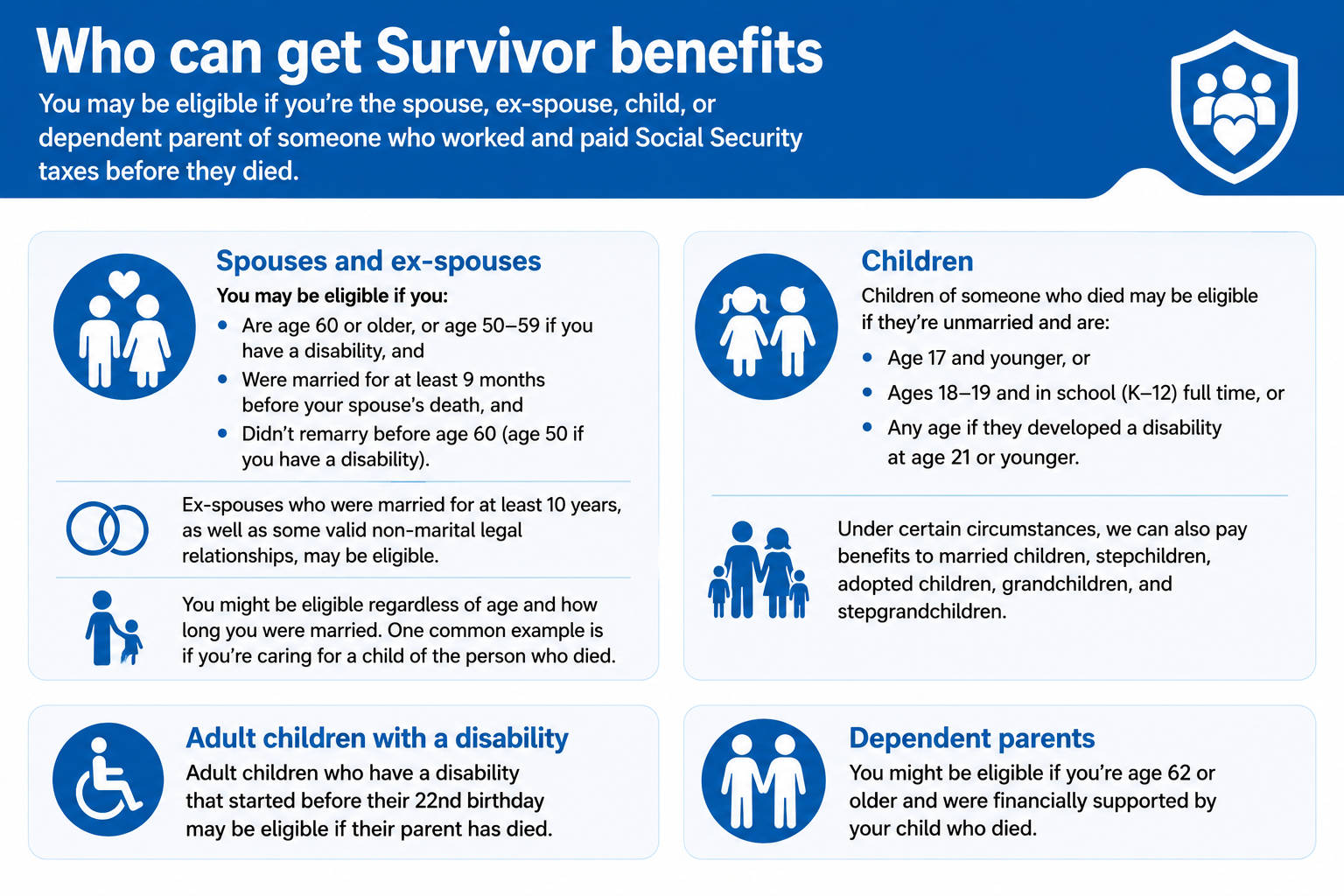
Eligible family members may include spouses, former spouses, children, dependent parents, and in some cases stepchildren, grandchildren, and adopted children. The amount received depends largely on the deceased worker's earnings history and the survivor's relationship to that worker.
Who Can Qualify For Survivor Benefits?
Several family members may qualify for Social Security survivor benefits. Eligibility rules vary based on age, marital status, disability status, and relationship to the deceased worker.
A surviving spouse may qualify at age 60 or older. A surviving spouse with a disability may qualify as early as age 50. A spouse caring for the deceased worker's child who is under age 16 or has a qualifying disability may also qualify regardless of age.
Benefits For Surviving Spouses
Surviving spouses often receive the largest survivor benefits. The amount depends on the spouse's age when benefits begin and the deceased worker's benefit amount.
A surviving spouse who waits until full retirement age can generally receive 100% of the deceased worker's benefit. A surviving spouse who starts benefits between age 60 and full retirement age typically receives between 71.5% and 99% of the worker's benefit. A spouse caring for a qualifying child can generally receive 75% of the worker's benefit.
Read: When Should You Claim Social Security For Retirement To Maximize Benefits?
Benefits For Divorced Spouses
Former spouses may also qualify for survivor benefits if they meet certain requirements. One of the most important rules involves the length of the marriage.
A surviving divorced spouse can qualify if the marriage lasted at least 10 years. The divorced spouse may receive benefits similar to those available to a surviving spouse, provided other eligibility requirements are met. In many cases, receiving survivor benefits as a divorced spouse does not reduce benefits paid to other eligible survivors.
Benefits For Children
Children may qualify for survivor benefits when a parent dies. These benefits can provide meaningful financial support during childhood and young adulthood.
Unmarried children generally qualify until age 18. Benefits may continue until age 19 if the child attends elementary or secondary school full time. Adult children with a disability that began before age 22 may qualify for lifetime survivor benefits under certain circumstances.
Benefits For Dependent Parents
Many people do not realize that dependent parents may also qualify for survivor benefits. This provision exists for parents who relied heavily on the deceased worker for financial support.
A parent generally must be at least age 62 and have received at least half of their support from the deceased worker. Eligible parents may receive monthly benefits based on the worker's earnings record if they meet Social Security requirements.
Also read: Are You Missing Key Family Tax Opportunities?
How Survivor Benefit Amounts Are Calculated
Social Security bases survivor benefits on the deceased worker's lifetime earnings. Workers who earned more and paid more Social Security taxes generally leave larger survivor benefits to eligible family members.
Benefit percentages vary by survivor category. A surviving spouse at full retirement age may receive 100% of the worker's benefit. Children typically receive 75%. Dependent parents may receive up to 82.5% if one parent survives or 75% each if two dependent parents qualify.
Understanding The Family Maximum Benefit
Social Security limits the total amount that a family can receive from one worker's earnings record. This limit is known as the family maximum benefit.
The family maximum generally falls between 150% and 180% of the deceased worker's benefit amount. If several family members qualify at the same time, Social Security may reduce individual payments so that total benefits stay within the allowed maximum.
What Is The Social Security Blackout Period?
The Social Security blackout period can create a temporary gap in survivor benefits. Many families remain unaware of this rule until they experience it firsthand.
A surviving spouse may receive benefits while caring for a child under age 16. However, those benefits usually stop once the child turns 16. The spouse may not become eligible for widow or widower benefits until age 60. This gap between eligibility periods is known as the blackout period and can last several years.
Can You Remarry And Still Receive Benefits?
Remarriage can affect eligibility for survivor benefits. The impact depends largely on the survivor's age at the time of remarriage.
In most cases, a surviving spouse who remarries before age 60 cannot continue receiving survivor benefits based on the deceased spouse's record. However, remarriage at age 60 or later generally does not prevent eligibility for survivor benefits.
Survivor Benefits Versus Your Own Retirement Benefit
Some surviving spouses qualify for both retirement benefits based on their own work record and survivor benefits based on a deceased spouse's record.
In many situations, Social Security pays the higher of the two amounts. Some survivors may choose to start one benefit first and switch later. For example, a surviving spouse may collect survivor benefits while allowing their own retirement benefit to grow until age 70.
The One Time Death Benefit
Social Security also offers a one time lump sum death payment. While modest, it may provide some immediate financial assistance.
The payment is currently $255. A surviving spouse who meets eligibility requirements generally receives this payment. If there is no eligible surviving spouse, an eligible child may receive the payment instead.
How To Apply For Survivor Benefits
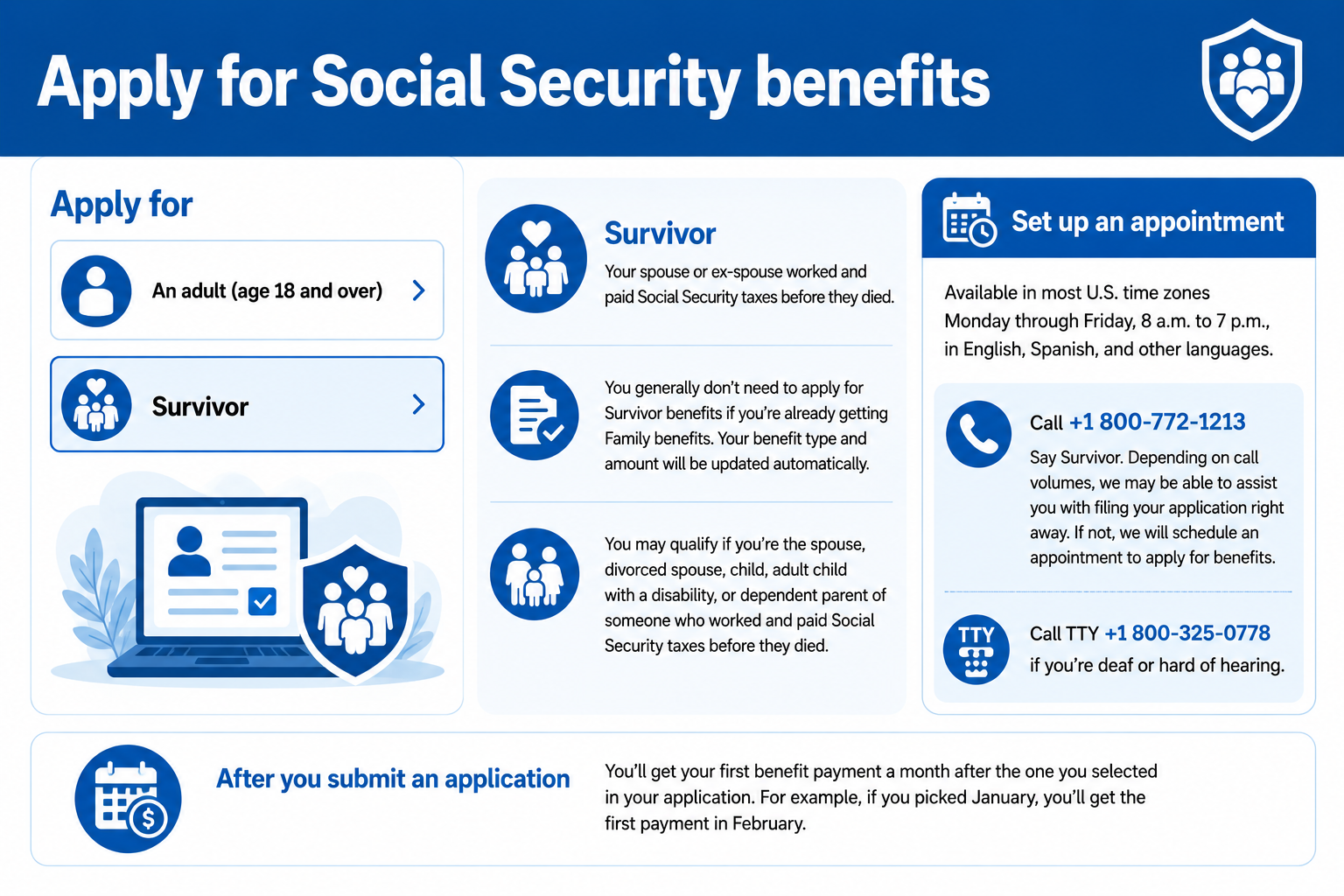
Families should contact the Social Security Administration as soon as possible after a death. Prompt action can help prevent delays and avoid missing benefits.
Applicants may need to provide a death certificate, Social Security numbers, birth certificates, marriage certificates, divorce decrees, and banking information. Survivor benefits applications can typically be completed by phone or through an appointment with Social Security.
Common Mistakes To Avoid
One common mistake is assuming Social Security automatically starts survivor benefits. In many cases, eligible family members must apply before benefits begin.
Another mistake involves claiming benefits without understanding all available options. A surviving spouse may benefit from comparing survivor benefits and personal retirement benefits before deciding when to claim. Careful planning can help maximize lifetime income.
How Survivor Benefits Fit Into A Retirement Plan
Social Security survivor benefits can play a meaningful role in retirement income planning. For many households, they represent a significant source of guaranteed income after the death of a spouse.
Understanding eligibility rules, timing strategies, and benefit amounts can help survivors make informed decisions. Reviewing these benefits as part of a broader retirement income strategy may help create greater financial stability during a difficult transition.
How A Virtual Family Office Helps
Social Security survivor benefits are only one piece of a much larger financial picture. Decisions about when to claim benefits can affect retirement income, taxes, investment withdrawals, and estate planning strategies. A Virtual Family Office helps coordinate these moving parts through a comprehensive approach that aligns your Social Security decisions with your overall financial goals. At ONE Advisory Partners, clients receive integrated guidance that combines retirement planning, investment management, tax strategies, and estate planning, helping families make informed decisions that support long term financial security.
Read: What Is Virtual Family Office and Why More Families Are Moving to It
The Bottom Line
Social Security survivor benefits can provide valuable financial support to spouses, former spouses, children, and dependent parents after the loss of a loved one. Understanding who qualifies, how benefits are calculated, and which claiming strategies may maximize lifetime income can help families avoid costly mistakes. If you want help coordinating Social Security decisions with your broader retirement, tax, investment, and legacy plans, the team at ONE Advisory Partners can help. Learn more about their Virtual Family Office approach and schedule a consultation.
FAQs
1. What are Social Security survivor benefits?
Social Security survivor benefits are monthly payments made to eligible family members of deceased workers who paid Social Security taxes.
2. At what age can a surviving spouse claim benefits?
A surviving spouse can generally claim benefits at age 60, or age 50 if disabled.
3. Can a surviving spouse receive 100% of the deceased spouse's benefit?
Yes. A surviving spouse who claims at full retirement age can generally receive 100% of the deceased spouse's benefit.
4. Can ex spouses receive survivor benefits?
Yes. A surviving divorced spouse may qualify if the marriage lasted at least 10 years and other requirements are met.
5. How much can children receive?
Eligible children can generally receive 75% of the deceased worker's benefit.
6. What is the Social Security blackout period?
The blackout period is a gap between the end of caregiver benefits and the beginning of widow or widower benefits.
7. Does remarriage affect survivor benefits?
Yes. Remarrying before age 60 can affect eligibility, while remarriage after age 60 generally does not.
8. Is there a one time death payment?
Yes. Social Security may pay a one time lump sum death benefit of $255 to an eligible survivor.
9. Can dependent parents receive survivor benefits?
Yes. Dependent parents age 62 or older may qualify if they relied on the deceased worker for at least half of their support.
10. How do I apply for survivor benefits?
You can contact the Social Security Administration by phone or schedule an appointment with a local office to begin the application process.
References
Investopedia. (2026). Social Security Survivor Benefits: Eligibility & How to Maximize. Retrieved from https://www.investopedia.com/personal-finance/social-security-survivor-benefits-work/
Social Security Administration. (2026). Survivors Benefits (Publication No. 05-10084). Retrieved from https://www.ssa.gov/pubs/EN-05-10084.pdf
Social Security Administration. (2025). How Social Security Can Help You When a Family Member Dies (Publication No. 05-10008). Retrieved from https://www.ssa.gov/pubs/EN-05-10008.pdf