Selling Your Business Soon? Start Tax Planning Now
Selling a business is often one of the largest financial events of your life. While many owners focus on finding the right buyer and negotiating the best price, the amount you keep after taxes can have an even greater impact on your future. Tax planning before selling a business gives you time to evaluate your options, reduce unnecessary tax liability, and align the sale with your long term financial goals.

Why Tax Planning Matters Before A Sale
Many business owners wait until they receive an offer before thinking about taxes. Unfortunately, some of the most effective tax planning opportunities require months or even years to implement. Once negotiations begin, your ability to make meaningful changes may become limited.
Starting early allows you to evaluate different deal structures, review your business entity, identify tax saving opportunities, and coordinate your legal, tax, and financial planning. The earlier you begin, the more flexibility you may have to improve your after tax outcome.
Understand Asset Sales And Stock Sales
One of the most important decisions involves how the transaction is structured. In an asset sale, the company sells individual assets. In a stock sale, the buyer purchases ownership interests in the company. Buyers often prefer asset sales because they may receive valuable depreciation and amortization benefits.
For sellers, the tax consequences can vary significantly. C corporations may face double taxation in an asset sale, while S corporations and LLCs often avoid this issue. However, some gains may still be taxed as ordinary income rather than long term capital gains. Depreciation recapture can also increase your tax bill when previously depreciated assets are sold.
Read: 7 Common Financial Blind Spots for High Earners
Consider How You Receive The Sale Proceeds
The timing of your payments can affect both your tax liability and your cash flow. Some transactions involve a lump sum payment at closing, while others spread payments over multiple years through an installment sale.
Installment sales may allow eligible gains to be recognized over multiple years, although not all assets qualify for installment treatment. This approach may help manage taxable income and improve cash flow. However, future tax rates could change, and there is always the risk that the buyer may fail to make future payments.
Be Aware Of Additional Federal Taxes
Many business owners focus on capital gains tax rates while overlooking other taxes that may apply. Long term capital gains generally receive favorable federal tax treatment, but additional taxes can increase your overall liability.
Certain taxpayers may also owe the 3.8% Net Investment Income Tax if their modified adjusted gross income exceeds IRS thresholds. In addition, depreciation recapture may cause part of the gain to be taxed at ordinary income tax rates. Understanding these rules can help you estimate your true after tax proceeds more accurately.
Also read: How Asset Location Changes When You Shift From Properties to Portfolios
State Residency Can Affect Your Tax Bill
Your state of residence at the time of sale can significantly impact the amount of tax you owe. Business owners living in high tax states may face substantial state income tax liabilities when selling their company.
Relocating to a lower tax state may reduce state tax liability, but the move must be completed and properly documented before the sale. States such as California and New York carefully review residency changes and may challenge taxpayers who cannot demonstrate a legitimate change of domicile.
Create A Pre-Sale Tax Planning Checklist
Before speaking with buyers, gather your financial records and ownership documents. This includes financial statements, tax returns, shareholder agreements, operating agreements, and documentation supporting ownership interests and cost basis.
Next, work with your CPA to estimate potential tax liabilities under multiple scenarios. Compare asset sales versus stock sales, evaluate payment structures, and estimate both federal and state tax exposure. Running these projections early can help identify opportunities before the deal structure becomes final.
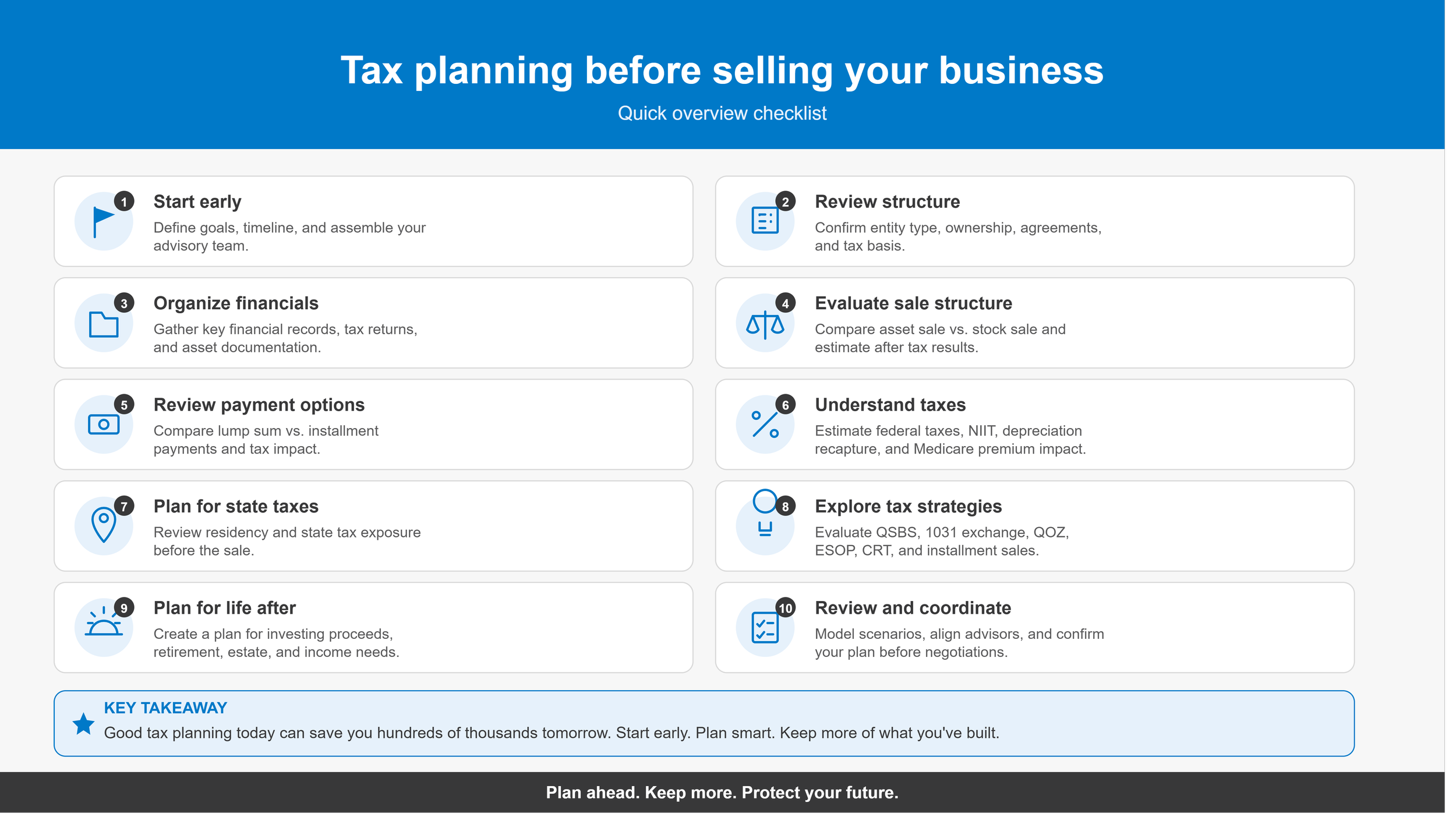
Explore Tax Planning Opportunities
Several tax planning strategies may be available depending on your circumstances, business structure, and timeline. These may include Qualified Small Business Stock treatment, installment sales, Employee Stock Ownership Plans, Charitable Remainder Trusts, or Qualified Opportunity Zone investments.
If qualifying investment or business real estate is involved, a Section 1031 exchange may allow the deferral of capital gains taxes when proceeds are reinvested into eligible replacement real estate. Because these strategies involve detailed rules and eligibility requirements, they should be evaluated well before a transaction begins.
Plan For Life After The Sale
Many owners spend years building a successful company but devote little time to planning what comes next. Once the business is sold, it no longer serves as a source of income or long term wealth accumulation.
Before closing, determine how much income you will need, how the proceeds should be invested, and how the sale fits into your retirement and estate planning goals. Having a clear plan can help reduce uncertainty and support better financial decisions after the transaction.
Build The Right Advisory Team
A successful business sale often requires collaboration among several professionals. Your CPA, business attorney, estate planning attorney, and financial advisor each play an important role in evaluating the transaction and protecting your interests.
Problems often arise when advisors work independently. Bringing everyone together early can improve communication, identify planning opportunities, and help avoid costly mistakes that could affect your after tax proceeds.
How A Virtual Family Office Helps
Selling a business affects nearly every aspect of your financial life. Tax planning, estate planning, investment management, retirement income planning, insurance decisions, and family wealth transfer strategies often become connected during the sale process.
A Virtual Family Office helps coordinate these areas through a single comprehensive strategy. Instead of having advisors working separately, your CPA, attorney, and financial advisor work together toward the same goals. This coordinated approach can help you evaluate after tax outcomes, identify planning opportunities, and create a long term plan for managing wealth after the sale.
Read: Why More Families Are Choosing a Virtual Family Office
Common Tax Planning Mistakes To Avoid
One of the most common mistakes is waiting until the year of the sale to begin planning. Many tax mitigation strategies require significant lead time and may no longer be available once negotiations are underway.
Another mistake is focusing only on the purchase price. Two offers with identical values may produce very different after tax outcomes depending on how the transaction is structured. Business owners should also avoid entering a transaction without a plan for managing the proceeds after closing.
The Bottom Line
Tax planning before selling a business involves much more than reducing taxes. The structure of the transaction, the timing of the sale, your state residency, and your long-term financial goals all influence how much of the proceeds you ultimately keep. The most valuable planning opportunities often exist long before a letter of intent arrives, which is why early planning can make a meaningful difference in your after tax outcome.
At ONE Advisory Partners, our Virtual Family Office approach helps business owners coordinate investment, tax, estate, and legacy planning before, during, and after a business sale. If you're considering an exit in the coming years, a conversation with our team can help you evaluate potential after tax outcomes and create a strategy that aligns the sale of your business with your broader financial goals.
FAQs
How Early Should I Start Tax Planning Before Selling A Business?
Many advisors recommend starting at least 18 to 24 months before a planned sale. Some advanced strategies may require even more time to implement effectively.
What Is The Difference Between An Asset Sale And A Stock Sale?
An asset sale involves selling company assets, while a stock sale transfers ownership interests in the business. The tax consequences can vary significantly between the two structures.
Can I Reduce Taxes By Spreading Payments Over Time?
Possibly. Installment sales may allow eligible gains to be recognized over multiple years, although not all assets qualify for installment treatment.
Will Selling My Business Affect Medicare Premiums?
A large taxable gain may increase your modified adjusted gross income and could trigger higher Medicare Part B and Part D premiums in future years.
Should I Change Residency Before A Sale?
Relocating to a lower tax state may reduce state tax liability in some situations. However, residency changes require proper planning and documentation and should be reviewed with legal and tax professionals.
What Tax Planning Strategies May Be Available Before A Sale?
Depending on your circumstances, strategies may include Qualified Small Business Stock treatment, Charitable Remainder Trusts, pre-sale charitable gifting strategies, Qualified Opportunity Zone investments, Employee Stock Ownership Plans, installment sales, or Section 1031 exchanges involving qualifying real estate.
Who Should Be Part Of My Advisory Team?
Many business owners benefit from working with a CPA, business attorney, estate planning attorney, and financial advisor. Coordinated planning among these professionals can help improve outcomes before and after the sale.
References
Internal Revenue Service. (2025). Net Investment Income Tax. Retrieved from https://www.irs.gov/individuals/net-investment-income-tax
Internal Revenue Service. (2025). Topic No. 409 Capital Gains And Losses. Retrieved from https://www.irs.gov/taxtopics/tc409
Internal Revenue Service. (2025). Publication 537 Installment Sales. Retrieved from https://www.irs.gov/forms-pubs/about-publication-537
Internal Revenue Service. (2025). Publication 544 Sales And Other Dispositions Of Assets. Retrieved from https://www.irs.gov/publications/p544
Internal Revenue Service. (2025). Opportunity Zones Frequently Asked Questions. Retrieved from https://www.irs.gov/credits-deductions/opportunity-zones-frequently-asked-questions
Internal Revenue Service. (2025). Like Kind Exchanges Real Estate Tax Tips. Retrieved from https://www.irs.gov/businesses/small-businesses-self-employed/like-kind-exchanges-real-estate-tax-tips
Social Security Administration. (2025). Medicare Income Related Monthly Adjustment Amount Appeal Form SSA 44. Retrieved from https://www.ssa.gov/forms/ssa-44.pdf